


In the late 1990s, the international football world witnessed something that felt like a bizarre dream. A tiny club from a quiet neighbourhood in Belgrade—the capital of Serbia, located in Southeast Europe—suddenly became the most feared and controversial team on the continent.
At the time, Belgrade was the heart of the Federal Republic of Yugoslavia, a nation struggling through the aftermath of brutal ethnic conflicts. Amidst this chaos, a football team rose from total obscurity to the biggest stages in Europe, driven not by a sporting project, but by the shadow of a warlord.

The Man Behind the Curtain: A Miracle Built on Fear
Željko Ražnatović, universally known as Arkan, was far from a typical club owner. He was a notorious criminal, a former bank robber, and the leader of a feared paramilitary group called “The Tigers.”

After he failed in his attempt to buy the famous Serbian giants, Red Star Belgrade, he turned his attention to FK Obilić in 1996. At that moment, Obilić was just a small side from a Belgrade suburb playing in the lower divisions. However, under Arkan’s command, they began a meteoric rise that saw them climb to the top of the national standings at a speed that defied logic.

By 1998, FK Obilić achieved the unthinkable: they won the Yugoslav League title, breaking the historic dominance of Red Star and Partizan Belgrade. While the trophy was physically real, the “miracle” was incredibly dark.
Reports from that era describe a league governed entirely by fear rather than talent. Arkan’s soldiers—men who had recently returned from the battlefields—would sit in the stands in their uniforms, staring down the referees to ensure every whistle went in favor of Obilić. Opposing players shared terrifying stories of being threatened in the stadium tunnels, while others were reportedly kidnapped or locked in car trunks to force them into signing contracts.
Arkan famously told the international media that his secret was a strict discipline and a diet of “bacon and garlic,” but the world knew the success was built on pure, systematic intimidation.
The Violent Journey Across Europe
The league title granted this small Serbian club a ticket to the Champions League, forcing them to travel across the continent to face some of Europe’s most legendary teams. This created a massive diplomatic headache for football officials:
To Munich, Germany: Obilić traveled northwest to face the giants Bayern Munich. The German football legends, led by Franz Beckenbauer, were disgusted by Arkan’s criminal reputation and refused to even acknowledge him or share a VIP box. On the pitch, Bayern’s professional quality was too much for the Serbians, winning 4-0 in Germany. However, the return leg in Belgrade ended in a 1-1 draw, a result Arkan used to claim that his “neighborhood team” could stand up to the best in the world.
To Madrid, Spain: After being eliminated from the Champions League, Obilić moved into the UEFA Cup to play Atlético Madrid. Because of strict international sanctions and a UN embargo against Yugoslavia, the team was forbidden from using their own national planes. They had to navigate a complicated and exhausting route through neighboring countries just to reach the Spanish capital.
The matches against Atlético Madrid were described by Spanish newspapers as a “war report” rather than a football summary. The Obilić players employed a style of play so violent that Atlético stars like Juninho and Jugovic were left with serious injuries. The atmosphere in the return leg, played at the Partizan stadium in Belgrade, was described as an “inferno” where the pressure from the stands was almost unbearable for the visiting Spanish side.

Ceca Raznatovic: When Arkan’s tigress visited the Calderón. To prevent UEFA from banning the club entirely due to his presence, Arkan officially stepped down and made his wife—the famous Serbian pop star Ceca—the club president. While Spanish police in Madrid were actively circulating “Wanted” posters with Arkan’s face on them, Ceca was the center of attention. She didn’t stay in the offices; she sat directly on the team bench as the official delegate, shouting tactical instructions and managing the players under the glare of hundreds of cameras.

Arkan’s Real Legacy, sadly
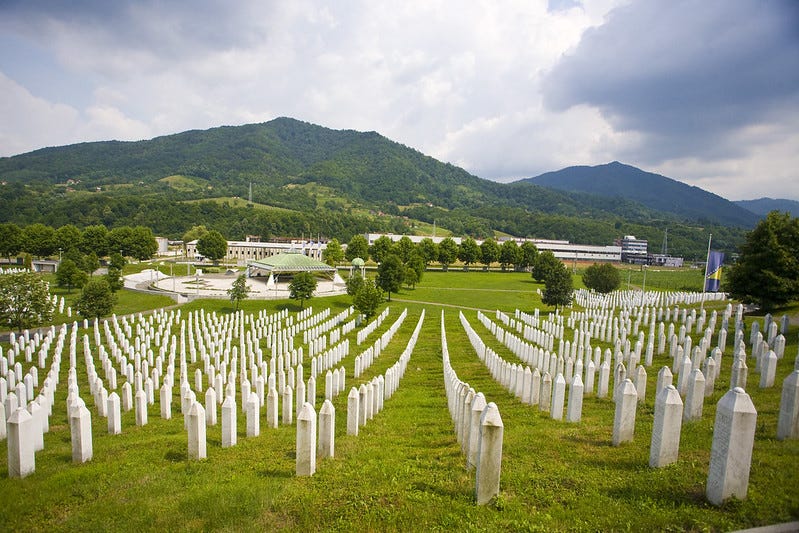
While he played the role of a football president, Arkan’s real legacy was one of blood and terror. As the leader of the “Serb Volunteer Guard” (the Tigers), he was responsible for extreme violence across Croatia and Bosnia. His forces were implicated in numerous atrocities, including ethnic cleansing, mass executions of civilians, and the systematic looting of towns. Arkan’s men were notorious for their role in the takeover of cities where hundreds of civilians were killed or forcibly displaced. In 1997, the International Criminal Tribunal formally indicted Arkan for crimes against humanity, specifically citing his responsibility for murder, torture, and the forced deportation of thousands of people.
The Collapse
So, the entire power structure of FK Obilić was tied to the life of one man. That empire of fear vanished on January 15, 2000, when Arkan was shot and killed in the lobby of the Intercontinental Hotel in Belgrade. His death marked the immediate end of the club’s era of influence.

Without Arkan’s shadow to protect them and his “Tigers” to intimidate the opposition, the club’s “magic” disappeared overnight. They lost their funding, their political protection, and their ability to win games. FK Obilić began a long, painful fall down the divisions, eventually disappearing from the professional map and landing in the 7th tier of Serbian football. Today, their stadium remains a quiet, decaying ghost of the past—a permanent reminder of a bizarre time when the capital of Serbia saw a warlord turn the “beautiful game” into a weapon of war and propaganda.
What’s your take? Can a sporting achievement ever be separated from the crimes of those who funded it? Let’s us know what you think.
Enjoyed this deep dive into football history?

If you want to explore the full story of every club that has ever competed on the European Cup/Champios League—from legendary giants to forgotten dynasties—check out European Cup: An Atlas of Champions. It features meticulously charted maps and profiles of over 550 clubs across 70 years of history.